Request Quote

AC Condenser Fan Not Working? Causes, Fixes & Repair Guide
- Certified Experts
- Same Day Service
- 24/7 Emergency Support
- 5000+ Happy Customers
- Google Rated Business
Is your AC blowing warm air while the outdoor condenser fan isn’t spinning? A faulty condenser fan is one of the most common reasons an air conditioner loses its cooling performance. Since the condenser fan removes heat from the outdoor unit, any problem with it can cause the entire system to overheat, reduce efficiency, and even damage the compressor.
The good news is that many condenser fan problems can be diagnosed early. In this guide, you’ll learn why your AC condenser fan is not working, the most common causes, troubleshooting steps, and when professional repair is the safest solution.
Why Is My AC Condenser Fan Not Working?
The condenser fan is located inside the outdoor AC unit. Its primary function is to remove heat from the condenser coils, allowing the refrigerant to cool before circulating back indoors.
When the fan stops working, heat becomes trapped inside the outdoor unit, forcing the air conditioner to work harder while providing little or no cooling.
- Common causes include:
- Faulty capacitor
- Failed fan motor
- Electrical problems
- Dirty condenser unit
- Broken fan blades
- Defective contactor
- Thermostat issues
- Compressor malfunction
- Identifying the root cause early can help prevent expensive AC repairs.
Signs Your AC Condenser Fan Is Not Working
- You may notice one or more of these warning signs:
- Outdoor fan is not spinning
- AC blowing warm air
- Outdoor unit overheating
- Higher electricity bills
- Loud buzzing or humming sounds
- Compressor shuts down unexpectedly
- Burning smell near the outdoor unit
- Ignoring these symptoms can lead to compressor failure, one of the most expensive AC repairs.
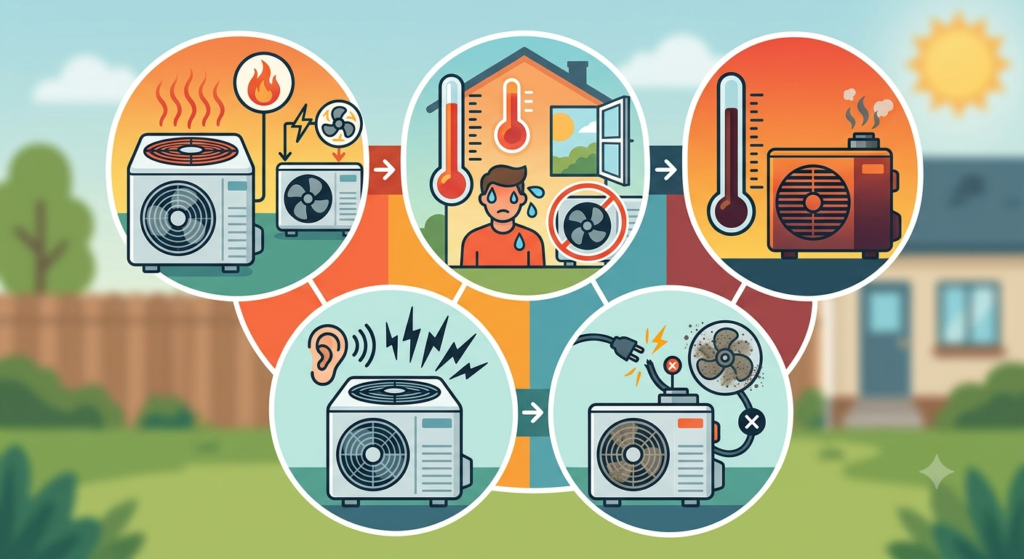
Common Causes of AC Condenser Fan Not Working
Faulty Capacitor
The capacitor supplies the electrical boost needed to start the condenser fan motor.
If it fails, the fan may not start or may stop shortly after running.
Signs
- Fan doesn't spin
- Humming sound
- Fan starts only when pushed manually
Solution
- Test the capacitor
- Replace a faulty capacitor
AC Fan Motor Failure
The condenser fan motor operates every time your AC runs. Over time, heat, age, and continuous operation can wear it out.
Signs
- Fan spins slowly
- Grinding noises
- Burning smell
- Fan completely stopped
Solution
- Inspect motor bearings
- Replace the motor if damaged
Electrical Problems
Loose wiring, damaged connections, blown fuses, or tripped breakers can interrupt power to the outdoor fan.
Signs
- Outdoor unit has no power
- Fan starts intermittently
- Breaker keeps tripping
Solution
- Inspect electrical connections
- Reset breaker if necessary
- Replace damaged wiring
Dirty Condenser Unit
Dust, sand, leaves, and debris can block airflow around the condenser fan.
Signs
- Reduced cooling
- Fan struggles to rotate
- Outdoor unit overheating
Solution
- Turn off power
- Remove debris
- Clean condenser fins carefully
Broken Fan Blades
Damaged or bent fan blades reduce airflow and place extra stress on the motor.
Signs
- Excessive vibration
- Loud noises
- Uneven fan movement
Solution
- Replace damaged blades
- Check fan balance
Faulty Contactor
The contactor supplies power to the compressor and condenser fan.
A defective contactor may prevent the fan from receiving power.
Signs
- Outdoor unit won't start
- Clicking sounds
- Fan remains stationary
Solution
- Test contactor
- Replace if faulty
Thermostat Problems
Incorrect thermostat settings or communication failures may prevent the outdoor unit from operating correctly.
Signs
- AC doesn't start cooling
- Fan never activates
- System cycles incorrectly
Solution
- Verify thermostat settings
- Replace batteries
- Inspect thermostat wiring
How to Fix an AC Condenser Fan That Isn't Working
Before calling an AC technician, try these basic troubleshooting steps.
Check the Power Supply
- Confirm the breaker hasn't tripped and power is reaching the outdoor unit.
Inspect the Thermostat
- Ensure cooling mode is selected and the temperature is set below room temperature.
Clean the Outdoor Unit
- Remove leaves, dust, and debris around the condenser.
Listen for Motor Noise
- A humming sound without fan movement often indicates a failed capacitor.
Inspect the Fan Blades
- Check for visible damage or obstructions preventing rotation.
When to Call an AC Repair Technician
Professional repair is recommended if:
- The fan motor has failed
- The capacitor needs replacement
- The breaker trips repeatedly
- Burning smells are present
- Compressor overheats
- Electrical components are damaged
- The AC still blows warm air after troubleshooting
Electrical and refrigerant-related repairs should always be performed by qualified technicians.
How to Prevent AC Condenser Fan Problems
Preventive maintenance helps improve cooling efficiency and extend AC lifespan.
- Clean the Outdoor Unit Regularly: Remove dust, leaves, and debris every few months.
- Schedule Annual AC Maintenance: Professional inspections identify worn components before they fail.
- Replace Worn Parts Promptly: Don’t delay replacing damaged capacitors, fan blades, or motors.
- Keep Proper Clearance Around the Unit: Maintain adequate airflow around the outdoor condenser.
- Monitor Cooling Performance: Address unusual noises or reduced cooling immediately.
AC Condenser Fan Troubleshooting Table
| Problem | Possible Cause | Recommended Solution |
|---|
| Fan Not Spinning | Faulty Capacitor | Replace Capacitor |
| Warm Air From AC | Failed Fan Motor | Motor Replacement |
| Outdoor Unit Overheating | Dirty Condenser | Clean Outdoor Unit |
| Breaker Keeps Tripping | Electrical Fault | Electrical Inspection |
| Loud Buzzing Noise | Defective Contactor | Replace Contactor |
Request A Quote Now
Our Services
Latest Post
-
How to Reset Your Washing Machine After a Power Cut
-
Which Fridge Gas Is Best – R134a vs. R600a
-
Why Your AC Struggles During Peak Heat in UAE
-
F1 Error SOLVED – Signature Top Load Washing Machine Repair Guide
-
Fridge Repair in UAE: What Affects the Repair Scope?
-
Washing Machine Door Not Locking? Causes & Fixes
-
أعراض عطل محرك مروحة التكييف | استكشاف أخطاء مكيفات الهواء في دبي وإصلاحها
-
Dishwasher Making Noise? Causes, Fixes & When to Call an Expert in Dubai
-
AC Remote Not Working Properly? Here’s What You Need to Know
-
Refrigerator Repair Service Near Me—Fast & Reliable Fridge Technicians
24/7 QUICK SUPPORT
Same-Day Emergency Appliance Repair in Dubai
Need urgent appliance repair services? Our experienced technicians provide fast same-day repair solutions across Dubai for refrigerators, washing machines, AC systems, ovens, dishwashers, and more.
- Fast Response
- Same-Day Repairs
- Affordable Service
- Expert Technicians
Frequently Asked Questions
A faulty capacitor, failed fan motor, electrical issue, or damaged contactor are the most common causes.
The system may run briefly, but continued operation can overheat the compressor and cause serious damage.
Common signs include slow fan movement, grinding noises, overheating, burning smells, or a fan that won't spin at all.
Yes. The capacitor provides the starting power required for the fan motor. A failed capacitor often prevents the fan from starting.
Professional AC maintenance should be performed at least once a year, while the outdoor unit should be cleaned regularly to maintain proper airflow.
Fan Motor Symptoms in More Detail: Repair or Replace?
Capacitor or motor? Tell them apart first. A humming fan that starts only when you push the blades is usually a failed capacitor — the motor is trying to start but has no boost. A fan that grinds, spins slowly, stops on its own, or smells of burning is usually a failing motor. Replacing the capacitor will not fix a worn motor, and a new motor will not fix a dead capacitor, so test the capacitor before ordering a motor.
Watch for motor overheating. A faulty fan motor often runs hot: the motor casing feels very hot to the touch, the unit shuts down frequently, and you may notice a burning smell near the outdoor unit. In Dubai’s heat, where outdoor units work in 35–45°C, a motor that overheats can also make the compressor overheat and shut down, which can lead to a full breakdown if it is ignored.
Repair or replace? Replace the motor when the fan does not spin at all even after a capacitor replacement, when grinding, weak airflow and overheating appear together, or when the motor is old and has already been repaired before. With regular maintenance an AC fan motor typically lasts about 10–15 years. Do a few simple checks first — listen for grinding or humming, watch the blades, check the filters and vents, and check the breaker — but leave motor, capacitor and electrical testing to a qualified technician. Book an AC repair service if the fan still will not run after the basic checks.
More Frequently Asked Questions
How long does an AC fan motor typically last?
With regular maintenance, an AC fan motor typically lasts about 10–15 years. Motors in Dubai work harder in high temperatures, so annual servicing, clean coils and good airflow help them last longer.
Can a dirty filter cause symptoms like a bad fan motor?
Yes. A clogged filter restricts airflow, so the AC works harder, cools poorly and may make unusual noises — symptoms that can look like a fan motor problem. Check and clean or replace the filter first before assuming the motor has failed.
What should I check first if my AC fan motor overheats?
Switch the AC off and let it cool down. Check for debris around the outdoor unit, a dirty filter and a tripped breaker, and look for a burning smell. Do not keep running an overheating unit — have the motor, capacitor and wiring checked by a technician.